

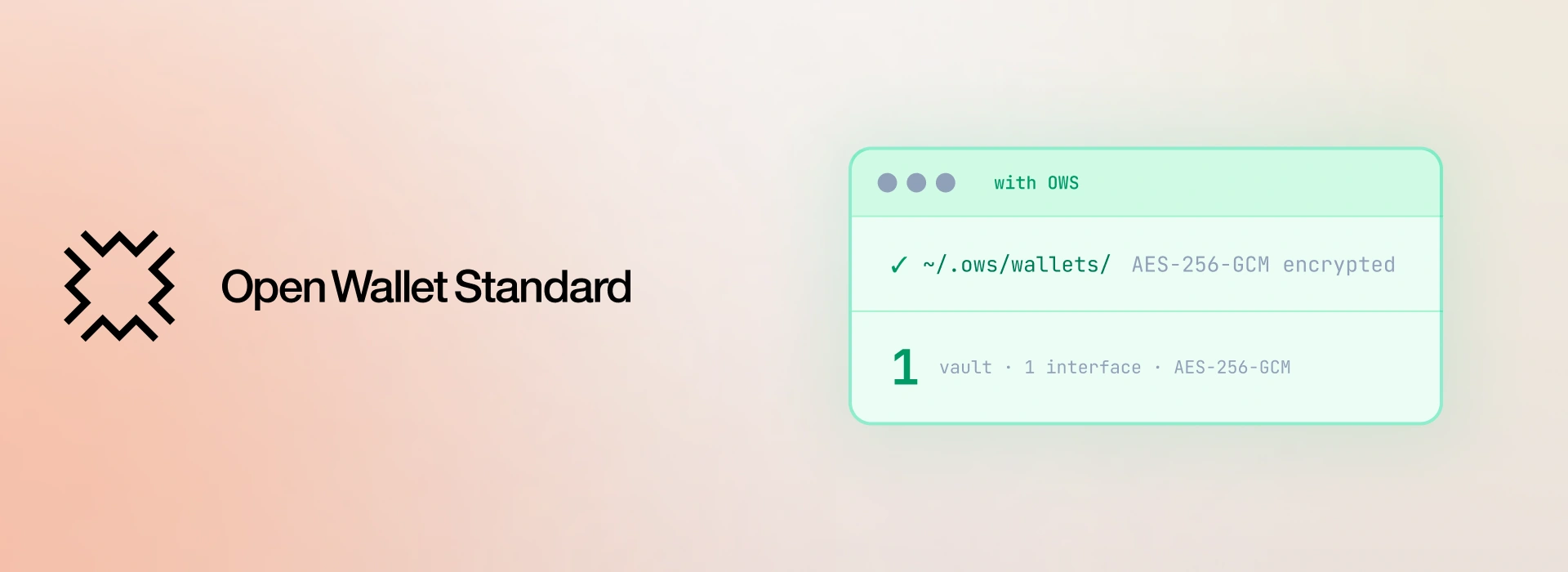
OPEN WALLET STANDARD
Company Overview.
Description.
The Open Wallet Standard (OWS) is an open-source specification that gives AI agents and developer tools a secure, universal way to hold value, sign transactions, and pay for services across every major blockchain — without ever exposing a private key. For neobank builders deploying autonomous agents, OWS solves the foundational problem: there is no shared standard for how AI agents interact with wallets.
Every agent framework today rolls its own key management. Private keys end up in environment variables, plaintext config files, and proprietary formats. A wallet created for one agent cannot be used by another. OWS replaces this fragmentation with a single open standard: one encrypted vault on the user’s machine, one interface for every chain, and a security model where the private key is never exposed to the agent, the LLM, or any parent process.
OWS supports EVM (Ethereum, Base, Polygon, Arbitrum, Optimism), Solana, Bitcoin, Cosmos, Tron, TON, Sui, Filecoin, Spark, and XRP Ledger — all from a single seed. The standard ships with native SDK bindings for Node.js and Python, a CLI, and an MCP server interface.
The standard grew out of MoonPay’s own product development. MoonPay took the wallet infrastructure behind MoonPay Agents, generalised it across chains and runtimes, and released it under an MIT licence. Contributors include PayPal, OKX, Ripple, Circle, the Ethereum Foundation, Solana Foundation, Base, Polygon, Sui, TON Foundation, and Tron.
Trusted By PayPal · OKX · Ripple · Circle · Ethereum Foundation · Solana Foundation · Base · Polygon · Sui · TON Foundation · Tron
Key Infrastructure.
CAIP-2 and CAIP-10 addressing abstracts away chain-specific details.
Private keys never pass through the LLM context.
Supports chain allowlists, expiry, spending limits, and optional custom executables.
No cloud accounts, no remote key management, no network dependency for signing.
Install via npm, PyPI, or build from source.
Agents built on any MCP-compatible framework access wallets through their native tool system.
Additional Features.
Seamlessly Works With.

MOONPAY 
MoonPay is a Fiat-to-Crypto Infrastructure supporting global rails featuring headless API integration, available for developer users in global markets.

ONRAMPER
OnRamper is a fiat-to-crypto onramp aggregator supporting cross-chain swaps featuring automated routing, available for developer users in 190+ countries.

MOONPAY AGENTS
MoonPay Agents is an AI agent financial infrastructure supporting multi-chain fiat rails featuring MCP integration, available for developers globally.

IRON
Iron is a stablecoin infrastructure API supporting EVM and Solana featuring USD/EUR virtual accounts, available for developer users in 180+ countries.

MOONPAY DEPOSITS
MoonPay Deposits is a crypto deposit infrastructure supporting fiat rails featuring chain abstraction, available for developer users in 180 countries.
General Questions.
If you are deploying AI agents that need to move value — trading agents, treasury agents, payment agents — each one currently needs its own wallet integration. OWS gives every agent a single, shared wallet layer. One vault, one interface, portable across tools and chains.
Existing wallet SDKs are either chain-specific, cloud-dependent, or designed for browser extensions. OWS is local-first, multi-chain from one seed, and designed specifically for programmatic agent access with a pre-signing policy engine.
OWS originated from MoonPay’s internal infrastructure for MoonPay Agents, but it is released under an MIT licence and maintained as an open standard with contributions from 15+ organisations.
Protocols like Coinbase’s x402 and Stripe’s Machine Payments Protocol define how agents pay for things. OWS defines where the wallet lives and how agents sign transactions. Any protocol that requires a signed transaction now has a common wallet to call.
