
Looking beyond on-chain visibility to understand the actual balance between the two payment networks
The crypto payment-card market has grown from a niche product into an increasingly important part of digital-asset infrastructure. Major exchanges, wallets, fintechs and payment companies are now allowing users to spend crypto and stablecoins through conventional card networks.
Yet one basic question remains surprisingly difficult to answer:
What is the actual market share of Visa versus Mastercard in crypto payment cards?
At first glance, the answer may seem straightforward. Public datasets that track crypto-card activity through identifiable blockchain transactions show Visa accounting for the vast majority of observable activity, at times exceeding 90%.
That would suggest that Mastercard represents only a small fraction of the activity captured by those datasets.
But when those figures are compared with disclosures from Visa and Mastercard themselves, SEC filings, major crypto exchanges, card issuers and payment infrastructure companies, a different picture emerges.
The issue is not that blockchain data is incorrect. Rather, the challenge is identifying and attributing the full scope of crypto-card spending across the many card programs operating on different networks. Crypto cards can draw from custodial exchange balances, self-custodial wallets, stablecoin accounts, or crypto-backed credit facilities, creating a diverse and fragmented on-chain footprint that makes comprehensive attribution difficult.
That distinction is fundamental to understanding the Visa-versus-Mastercard market.
After reviewing the available data from both networks and major crypto-card programs, the evidence does not provide sufficient basis to conclude that Visa is the clear market leader. To understand the balance between the two giants, we need to look beyond the initial blockchain-visible data and examine the broader evidence across the crypto-card ecosystem.
The first data point: TODEY’s own card ecosystem
TODEY currently tracks:
- 188 Visa and 101 Mastercard
Some card programs and tiers operate across both Visa and Mastercard, depending on the region, issuer, product tier, or other market-specific factors.
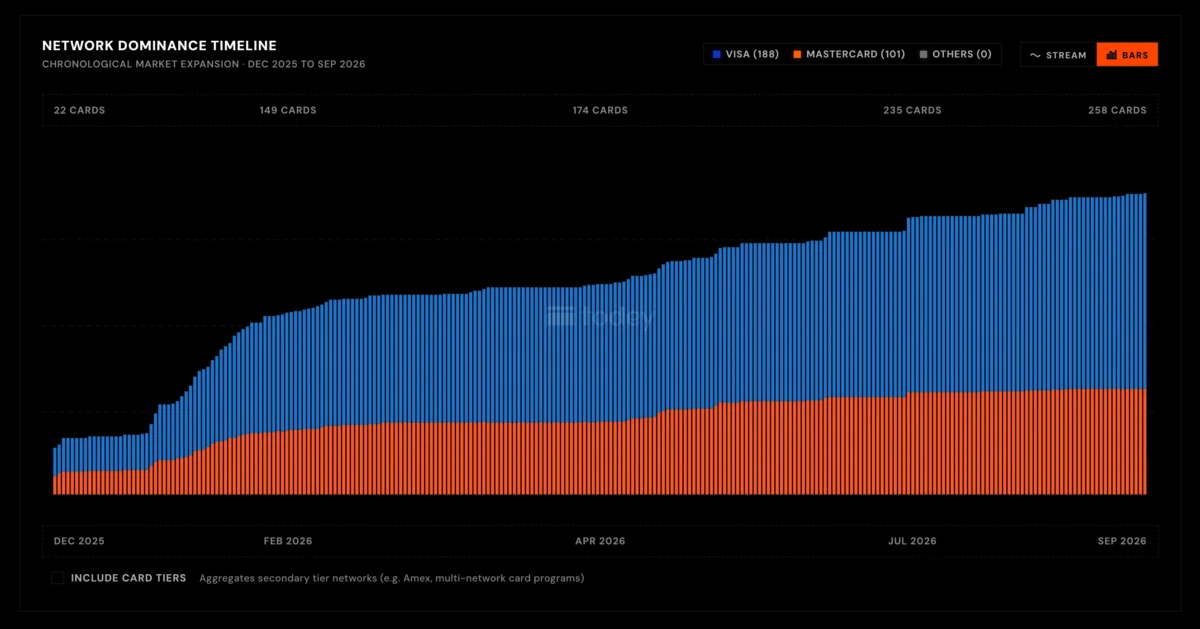
That represents approximately 64.5% Visa, 34.5% Mastercard, and 1% Others among these identified card records.
Those numbers should not be interpreted as transaction-volume market share. A card program with millions of active users can generate vastly more spending than a small card program, so program count and payment volume are fundamentally different measurements.
Nevertheless, the TODEY dataset establishes an important starting point:
Mastercard already represents a substantial portion of the identifiable crypto-card ecosystem.
That is difficult to reconcile with the view that Mastercard represents only a small share of the broader market based solely on the portion of activity visible or tracked through blockchain data.
To understand the discrepancy, we need to look at the networks themselves.
Visa has disclosed billions of dollars of crypto-card volume
Visa is currently much more transparent about its aggregate crypto-card volume.
In a March 31, 2026 publication, Visa reported that stablecoin-linked cards processed approximately $5.2 billion in volume during 2025, representing a 319% year-over-year increase. Visa also said that more than 130 stablecoin-linked card programs were operating across more than 50 countries.
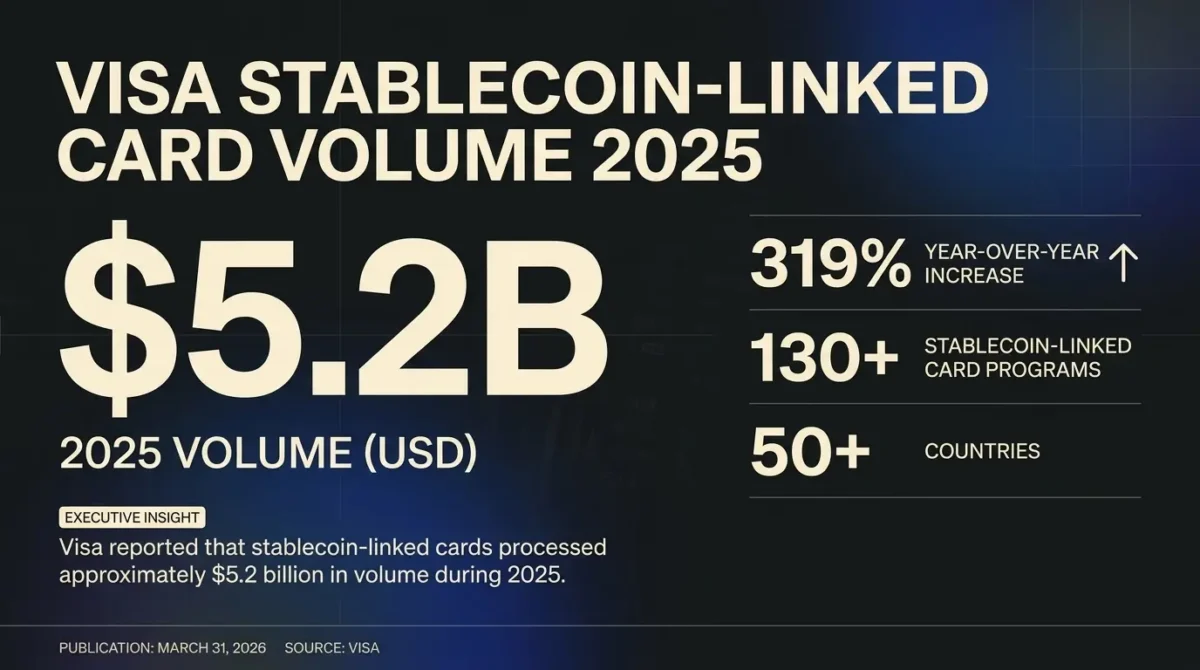
This is one of the most important numbers available in the market because it comes directly from Visa.
It is not a reconstruction based on blockchain transactions.
Visa subsequently reported that more than 160 stablecoin-linked card programs were live globally by its fiscal second quarter of 2026, with payment volume on those programs growing nearly 200% year over year. Visa also reported stablecoin settlement volume at a more than $20 billion annualized run rate.
The figures should not be conflated. The $20 billion figure relates to stablecoin settlement activity, while the $5.2 billion figure is the more relevant benchmark for stablecoin-linked card payment volume.
The important conclusion is clear:
Visa has a multi-billion-dollar crypto-card business, and that business is growing rapidly.
The question is how Mastercard compares.
Mastercard’s disclosures reveal a much larger ecosystem than tracked on-chain activity suggests
Mastercard’s reporting presents a different challenge.
The company’s 2025 Form 10-K states that it enabled consumers to spend crypto and stablecoin assets across Mastercard’s acceptance network through approximately 130 crypto co-brand card programs.
The two networks had developed broadly comparable numbers of crypto-linked card programs even though blockchain-visible volume can make the networks appear dramatically different.
Mastercard CEO Michael Miebach reinforced this during the company’s Q3 2025 earnings call:
“We have approximately 130 crypto co-brand card programs in market, with associated volumes and transactions growing at a healthy clip.”
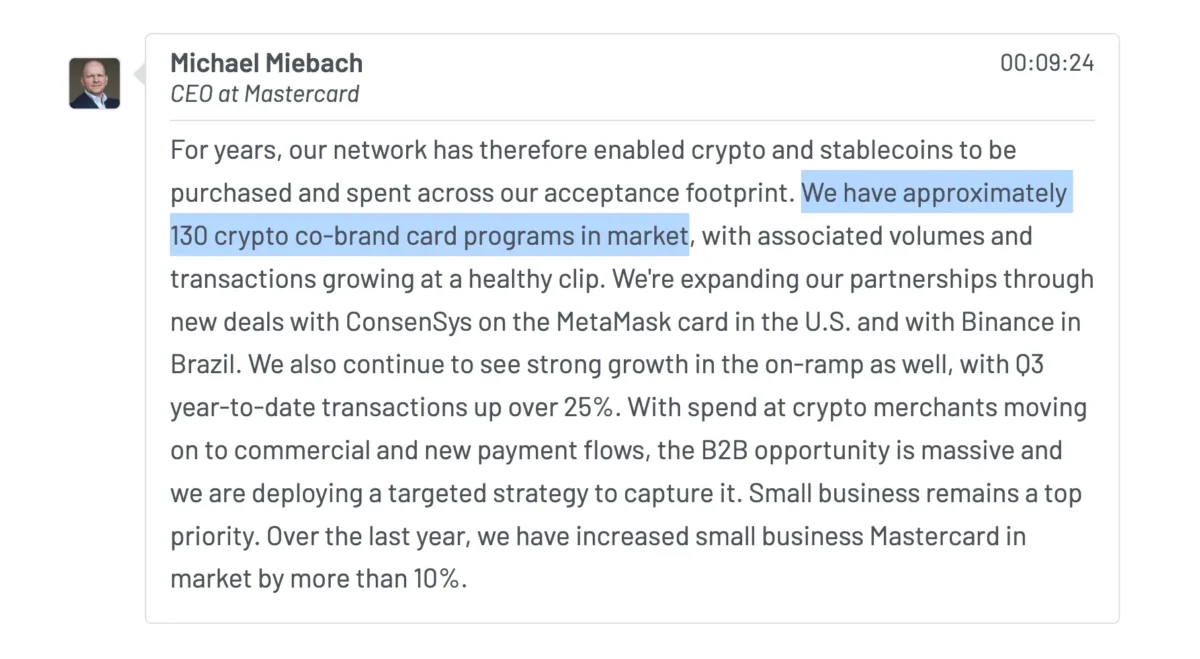
He also said Mastercard was expanding its relationships with MetaMask in the United States and Binance in Brazil.
The following year, Mastercard management provided an even stronger indication of the trajectory.
During the Q2 2026 earnings call, Miebach said:
Mastercard had expanded its relationships with Bitget and Kraken during the quarter.
This is direct commentary from Mastercard’s CEO.
There is, however, one crucial limitation:
Mastercard has not publicly disclosed a network-wide dollar figure for crypto co-brand card volume comparable to Visa’s $5.2 billion figure.
That prevents anyone from calculating an exact global Visa-versus-Mastercard percentage from company disclosures alone.
But it does not mean Mastercard’s volume is insignificant.
Mastercard’s partner ecosystem includes some of crypto’s largest platforms
One of the strongest reasons to question an extremely low Mastercard market-share estimate is the scale of the companies using Mastercard infrastructure.
Mastercard’s crypto-card ecosystem includes major names such as:
Binance, Bitget Wallet, Bybit, Gemini, Kraken, MetaMask, Nexo, OKX or even Revolut.
These include some of the industry’s largest crypto exchanges, wallets and digital-asset platforms.
Mastercard has explicitly described its stablecoin strategy as enabling consumers to spend crypto and stablecoins through its acceptance network, working with major crypto platforms and payment partners.
The challenge is not whether these transactions exist on-chain, but reliably identifying and attributing them to the specific card programs and networks involved.
This creates a significant measurement gap between what is happening on-chain and what can be confidently attributed to individual card programs.
Bybit: more than three million card users
Bybit provides one of the clearest examples of Mastercard’s reach.
In July 2026, Bybit reported that more than three million users globally use the Bybit Card to pay at merchants. The card operates through Mastercard’s payment network.
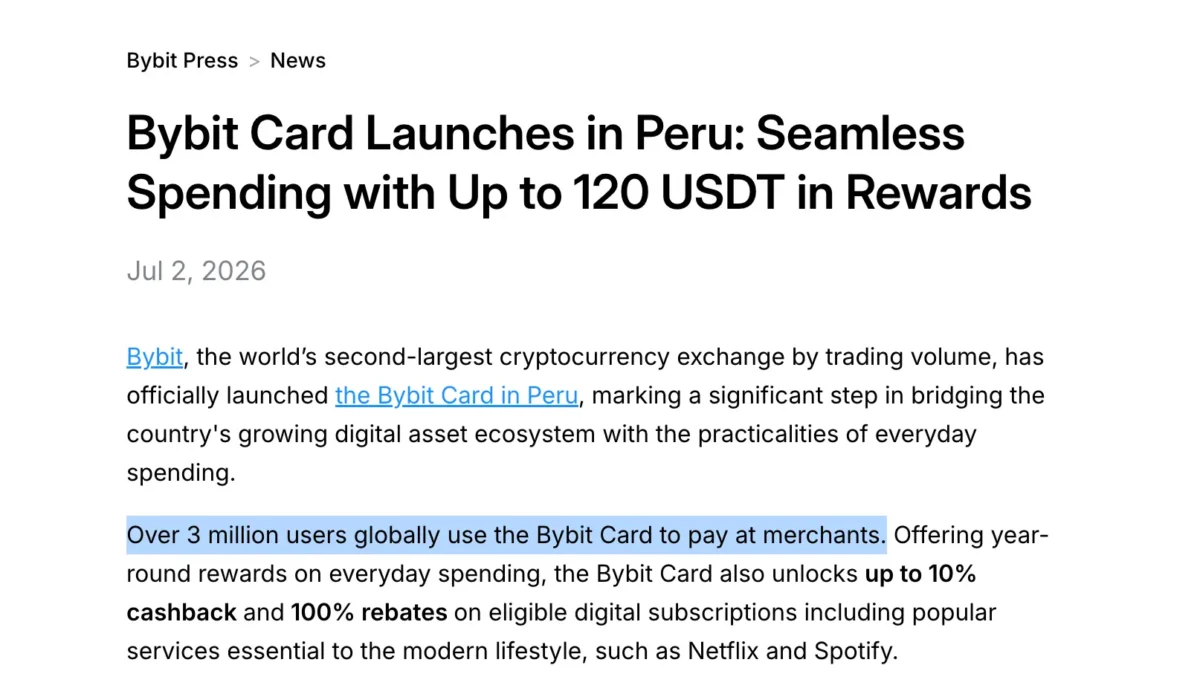
A user count is not the same as transaction volume, so Bybit’s disclosure cannot be presented as measured transaction volume. However, it provides a basis for a conservative scenario.
Using deliberately conservative assumptions — 3 million card users, if 25% active spenders, and just $200 in average monthly spending per active user:
3,000,000 × 25% × $200 × 12 = $1.8 billion in annual card transaction volume.
This $1.8 billion is a TODEY scenario, not a Bybit-reported transaction-volume figure. It assumes only $2,400 of annual spending per active card user.
Bybit has not publicly disclosed an aggregate card transaction-volume figure, but the scale of its cardholder base indicates that its Mastercard-linked activity could be substantial.
Binance: a major exchange connected to Mastercard’s global network
Binance is another important part of the picture.
The Binance Global Card Program operates through Immersve, a card issuer licensed by Mastercard under the Mastercard Global Reach Partner Program, allowing eligible customers to spend crypto through the Mastercard network at more than 90 million merchants worldwide.
The significance is that one of the world’s largest custodial crypto platforms has connected its customer ecosystem to Mastercard’s payment infrastructure.
The card can be used to spend crypto through Mastercard’s conventional payment network, while the underlying crypto balance is handled within the Binance and card-program infrastructure.
The lack of a published Binance or Bybit card-volume figure is therefore a major missing variable in any attempt to estimate Mastercard’s total crypto-card market share.
OKX: rapidly growing Mastercard card spending
OKX provides one of the clearest 2026 indicators that crypto-card adoption continues to accelerate.
In an August 2026 article written by Erald Ghoos, CEO of OKX Europe, the company reported that spending on crypto-linked cards across the industry reached an all-time high of $759 million in July.
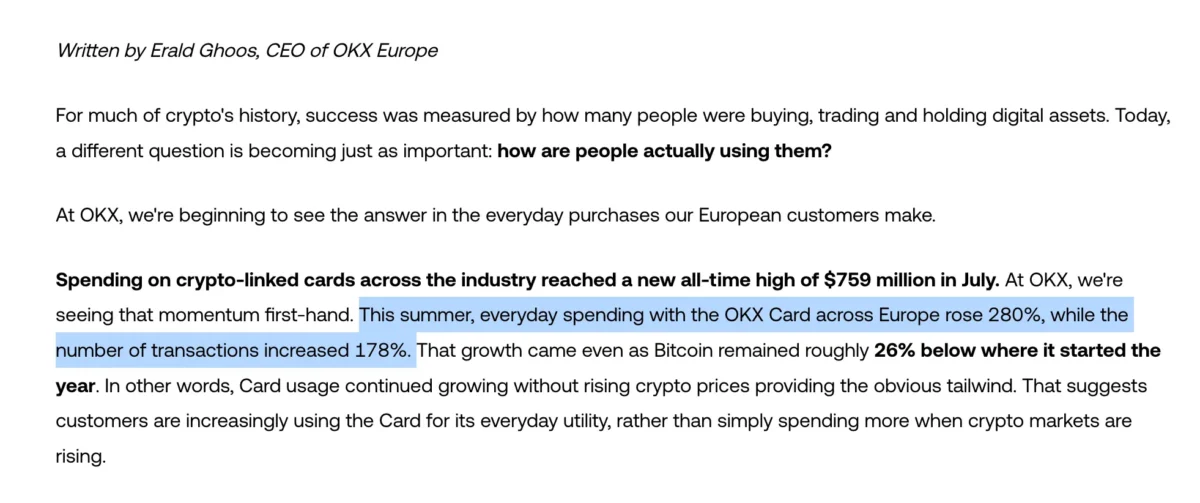
Ghoos also reported that spending with the OKX Card across Europe had increased 280%, while the number of transactions increased 178% during the summer.
Again, OKX has not disclosed its absolute card-spending total, so its contribution cannot simply be inserted into a market-share calculation.
But it provides another major data point showing that crypto-card spending is expanding rapidly, while OKX’s EEA card adds to Mastercard’s growing ecosystem.
Kraken: another major exchange entering the Mastercard market
Kraken launched the Kraken Card in July 2026, giving eligible customers in the United Kingdom and European Economic Area the ability to spend crypto and cash wherever Mastercard is accepted.
Kraken says the card supports more than 600 crypto and cash currencies, with supported assets converted near the time of purchase.
Mastercard’s Q2 2026 earnings commentary specifically identified Kraken as one of the relationships it expanded during the quarter.
The Kraken Card is managed through Krak, Kraken’s global money app, which now brings Kraken’s exchange and payment products under a broader platform. Krak also offers a Visa card in the United States, meaning the broader Kraken/Krak ecosystem now spans both major card networks.
Bitget provides a rare hard crypto-card volume number
Bitget Wallet offers one of the clearest recent examples of disclosed crypto-card spending.
Bitget reported that Bitget Wallet Card spending reached $31 million during the first half of 2026, representing a 191% increase from the previous half-year period.
This is particularly valuable because it is an actual card-spending figure reported by the company rather than an estimate inferred from blockchain transactions.
The program had also issued more than 150,000 cards across more than 50 markets.
The $31 million figure should not be treated as Mastercard-only volume, as Bitget’s card infrastructure operates across different payment networks depending on the market.
Nevertheless, it provides another independently disclosed datapoint demonstrating that significant crypto-card spending exists outside the narrow activity that can be identified through on-chain attribution.
And Bitget is only one program.
Nexo demonstrates real stablecoin spending through Mastercard
Nexo provides another direct example of crypto-funded consumer spending through Mastercard.
During the 2023–2024 holiday period, Nexo reported $50,318,595 in transaction volume generated by Nexo Card holders.
Its 2024 Card Report also stated that 65% of Nexo Card debit transactions in 2024 were made using stablecoins.
This is particularly relevant to the crypto-card market because it demonstrates actual stablecoin-funded consumer spending rather than simply a traditional card offering crypto rewards.
Nexo has not publicly disclosed a newer aggregate dollar figure for total Nexo Card transaction volume that we could verify. However, the $50.3 million holiday-period figure provides a meaningful historical datapoint, and given the subsequent growth of crypto-card adoption and spending, Nexo’s current transaction volume may be materially higher. The absence of a newer public figure means its contribution cannot be quantified reliably, but it should not be overlooked when assessing the broader Mastercard ecosystem.
Once again, the volume is disclosed by the card provider itself rather than reconstructed from blockchain activity.
Gemini provides one of the strongest SEC-filed datapoints
Gemini provides one of the strongest publicly disclosed datapoints in Mastercard’s crypto-card ecosystem.
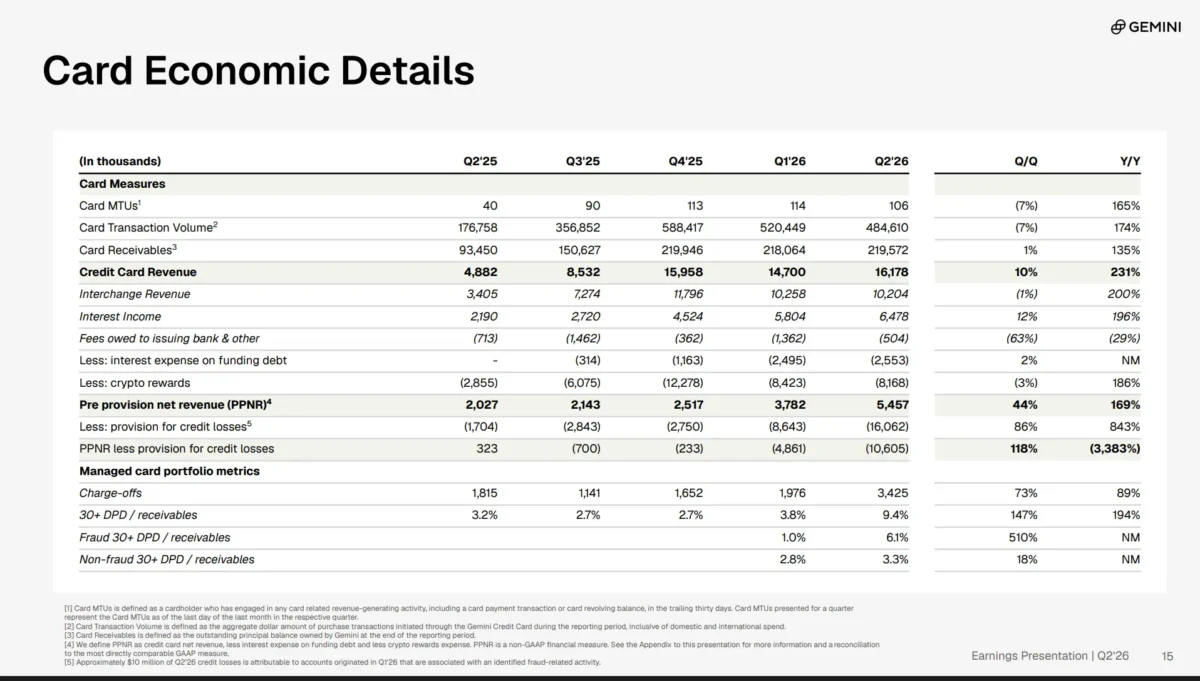
Gemini reported that its Mastercard-powered Gemini Credit Card generated approximately $484.6 million in transaction volume during Q2 2026, up 174% year over year. Combined with Q1, the card generated approximately $1.0 billion in transaction volume during the first half of 2026.
Gemini’s Q2 2026 results also showed credit-card revenue continuing to grow rapidly, increasing 231% year over year.
This figure must be interpreted carefully. The Gemini Credit Card is fundamentally a crypto-rewards credit card, rather than a pure crypto-spending product. Therefore, its transaction volume should not be treated as equivalent to Visa’s stablecoin-linked card volume.
However, it remains strong evidence of the scale of Mastercard’s crypto-linked card ecosystem: one Mastercard-powered crypto-related card program alone generated approximately $485 million in transaction volume in a single quarter during 2026.
The architecture of crypto cards explains much of the discrepancy
To understand why different datasets can produce different estimates, it is important to consider how crypto-funded card payments are structured.
Crypto cards can connect to custodial exchange balances, self-custodial wallets, stablecoin balances or crypto-backed credit facilities. Mastercard supports multiple models, including cards that allow users to maintain control of their assets until payment.
The underlying transactions can be traced on-chain, but identifying and reliably attributing them to the specific card programs and networks involved is not always straightforward.
That is why:
The amount of card spending that can be identified and attributed through blockchain data is not necessarily the same as the amount that can be confidently attributed to Visa or Mastercard at the network level.
Why Visa can dominate tracked on-chain activity without representing the entire card market
Visa’s apparent dominance in blockchain-visible crypto-card activity should not simply be dismissed.
Visa has a genuinely large crypto-card business and has disclosed billions of dollars in volume.
Its stablecoin-linked card ecosystem is also particularly strong among newer stablecoin-native infrastructure providers.
That means Visa can legitimately appear highly dominant in an on-chain dataset.
The problem arises when that observed share is then interpreted as:
Visa’s share of all crypto-card spending worldwide.
Those are different statements.
A blockchain-based dataset can tell us what it can observe and attribute.
A card network can observe transactions that occur through its authorization, clearing and settlement infrastructure regardless of whether the underlying crypto funding transaction is publicly visible.
Mastercard’s own description of its stablecoin strategy explicitly reflects this broader architecture, including crypto and stablecoin spending and conventional card-network settlement.
The more crypto cards resemble conventional payment cards with crypto-funded balances behind them, the more important this distinction becomes.
What the numbers allow us to calculate
Visa provides the clearest benchmark:
$5.2 billion of stablecoin-linked card volume in 2025
Mastercard has not published an equivalent network-wide dollar figure. But the available disclosures from its largest crypto-payment partners provide a much clearer indication of the scale involved.
What the Mastercard data suggests
On the Mastercard side, two of the strongest available datapoints come from Gemini and Bybit.
Gemini’s Mastercard-powered Credit Card generated approximately $1.95 billion in card transaction volume during the 12 months from July 2025 through June 2026.
Bybit reported more than 3 million users globally using the Bybit Card. Even under a deliberately conservative scenario in which only 25% of those users are active spenders and each spends just $200 per month, the implied annual card transaction volume is:
3,000,000 × 25% × $200 × 12 = $1.8 billion
Together, Gemini and this conservative Bybit scenario indicate approximately $3.75 billion in annualized card transaction volume from just two major Mastercard-linked programs.
That figure does not include potential volume from Mastercard’s broader crypto ecosystem, which includes major programs connected to Binance, Nexo, Bitget, OKX, MetaMask, Kraken, MoonPay and others.
The $3.75 billion figure is not Mastercard-reported network volume. It combines Gemini’s reported transaction volume with a conservative TODEY scenario for Bybit. Nevertheless, it demonstrates how quickly Mastercard’s potential volume can reach several billion dollars when only a small portion of its largest programs is considered.
The result is also highly sensitive to the assumptions used for Bybit. A higher proportion of active users or a higher average monthly spend would increase the implied volume materially. The undisclosed transaction volumes of Mastercard’s other major crypto-payment partners could add substantially more.
Mastercard CEO says crypto co-brand volume has more than tripled over two years, while the company continues to add relationships with major crypto platforms.

The Mastercard ecosystem now spans some of the industry’s most important exchanges, wallets and crypto-native payment companies.
- Bybit has reached millions of cardholders.
- OKX is reporting triple-digit spending growth.
- Bitget Wallet is reporting rapidly increasing card spending.
- Kraken launched its Mastercard card in 2026.
- These developments suggest that the balance between the two networks is still changing.
- The market share observed today should therefore not be treated as permanent.
On the other hand, Visa is expanding its crypto-card ecosystem just as aggressively.
- Rain scaled sharply in 2025, with annualized payment volume growing 38× and active card programs increasing 30%. The company now works with more than 200 partners, giving Visa a growing crypto-native issuing and settlement layer.
- Western Union launched Stablecard with Rain and Visa in August 2026, bringing a USD-stablecoin-backed card to Western Union customers that can be used anywhere Visa is accepted.
- Visa and Bridge expanded their stablecoin card partnership to more than 100 countries, with Bridge-enabled cards already live in 18 countries
- Visa’s stablecoin-linked card programs surpassed 160 globally in 2026, with payment volume across those programs up nearly 200% year over year.
TODEY’s market share assessment
The available data does not allow us to calculate an exact global market share for Visa and Mastercard. Neither network has disclosed a directly comparable, network-wide figure for total crypto-card transaction volume.
What the evidence does show is that there is no definitive global market-share leader in crypto payment cards today. The two networks appear to be building their positions across different parts of the ecosystem and, in many respects, are moving forward side by side.
Mastercard has developed a particularly strong presence among major crypto-native platforms, including large exchanges, wallets and established crypto businesses. Visa, meanwhile, has been highly active in enabling banks, fintechs and emerging payment providers to launch and scale stablecoin-linked card programs.
This difference in partner mix is important. Mastercard’s strength is particularly visible among established crypto platforms, while Visa has built significant momentum through financial institutions, fintechs and newer stablecoin-focused infrastructure providers.
The evidence therefore points to a market in which both networks have established significant positions, rather than one in which a single network clearly dominates. The exact balance remains difficult to measure, but the available data increasingly suggests that Visa and Mastercard are competing much more closely in crypto payments than blockchain-visible activity alone would indicate.
A clearer picture of the balance between Visa and Mastercard will likely emerge as the crypto-card market matures and more transaction data becomes publicly available. Future disclosures from Visa and Mastercard, as well as reporting from card issuers, crypto platforms and payment infrastructure providers, should make it easier to understand the scale and distribution of activity across the two networks.
For now, the more important takeaway is that crypto cards are moving beyond a niche financial product and becoming part of everyday payments.
Methodology note
This analysis uses publicly disclosed information from Visa, Mastercard, SEC filings, crypto exchanges, card issuers, wallets and payment-industry companies. Program counts, cardholder numbers and transaction volumes are treated as different metrics and are not mechanically combined. Where a company has not disclosed an aggregate network-level volume figure, TODEY does not present an inferred figure as reported data. Modeled figures are explicitly identified as TODEY analytical assumptions and are not presented as Mastercard-reported volume.